
Table of Contents
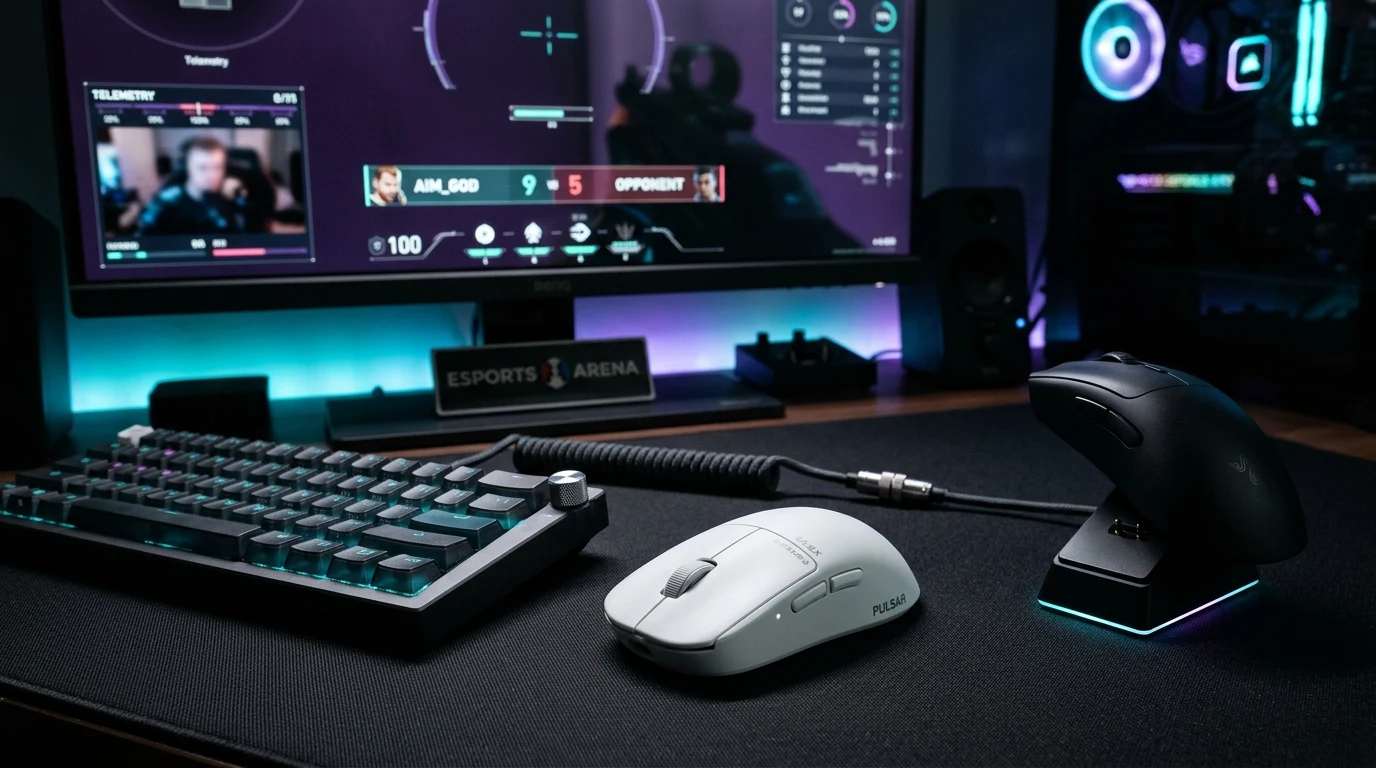
In competitive first-person tactical shooters like Valorant and Counter-Strike 2, victory is decided in fractions of a millisecond. A microscopic delay in click registration, a stutter in mouse sensor tracking during a high-speed 180-degree flick, or a keyboard key resetting half a millimeter too slowly can mean the difference between winning a tournament clutch and watching the rest of the round from spectator mode.
Two hardware innovations have completely reshaped competitive peripherals: sub-45-gram wireless mice with 8000Hz (8K) polling rates, and magnetic Hall Effect analog keyboards capable of “Rapid Trigger” technology. In this guide, we evaluate enthusiast disruptor ATK Gaming Gear (makers of the viral Blazing Sky F1 and RS7 magnetic keyboards) against the global esports king, Razer (creators of the Viper V3 Pro and Huntsman V3 Pro). We compare click latency, sensor tracking precision, Rapid Trigger analog actuation, battery efficiency, and price-to-performance value.
| Feature / Metric | ATK Gaming Gear | Razer |
|---|---|---|
| Mouse Weight Class | Ultra-lightweight 38g – 45g (Solid shell without honeycomb holes) | Ultra-lightweight 54g – 58g (Viper V3 Pro) |
| Optical Sensor | Flagship PixArt PAW3950 Ultra (up to 30,000 / 42,000 DPI overclocked) | Focus Pro 35K Gen-2 Optical Sensor |
| Wireless Polling Rates | True 8000Hz (8K) wireless polling dongle included | True 8000Hz (HyperPolling wireless dongle included) |
| Keyboard Switch Tech | Gateron Magnetic Hall Effect Switches with 0.02mm Rapid Trigger | Razer Analog Optical Switches Gen-2 (Rapid Trigger 0.1mm) |
| Software Configuration | Lightweight web-based browser driver (Zero bloatware, onboard memory) | Razer Synapse desktop software (rich ecosystem, background memory overhead) |
| Mouse Shell Coating | Ice-feel micro-etched matte coating (sweat-resistant chalky grip) | Smooth matte finish with optional grip tape included |
| Price Range | $59 – $110 (Mice & Keyboards) | $149 – $250 |
| Best Suited For | Hardcore FPS aimers, sub-40g weight purists, no-bloatware setups | Mainstream esports tournament players, broad ecosystem sync |
Mouse Engineering: 38 Grams & The PixArt PAW3950 Ultra Sensor
Weight reduction has reached astonishing levels. While early lightweight mice relied on perforated honeycomb shells that accumulated dust and sweat, modern engineering achieves featherweight mass with solid unibody shells:
- ATK Blazing Sky Series: Weighing as little as 38 to 45 grams, the ATK Blazing Sky feels practically weightless in the hand. Combined with pure 100% Virgin PTFE skates, the mouse starts and stops with zero initial friction resistance, allowing for instantaneous micro-adjustments on target heads. Powered by the customized flagship PixArt PAW3950 Ultra sensor and Nordic 52840 MCU, it tracks flawlessly across cordura, glass, and hybrid cloth mousepads at 750 IPS tracking speeds without spinouts.
- Razer Viper V3 Pro: Razer’s flagship esports weapon is a masterclass in balanced ergonomics. At 54 grams, it provides slightly more physical hand presence and palm support, preferred by players who use a claw-palm hybrid grip. Razer’s Gen-3 optical switches eliminate debounce delay and are immune to double-clicking issues.
Keyboard Superiority: Magnetic Hall Effect & Rapid Trigger Mechanics
Mechanical keyboard switches have a physical contact leaf: you must press down past a fixed actuation point (e.g., 2.0mm) to register a keystroke, and the key must travel all the way back up past the reset point before you can press it again. Magnetic Hall Effect switches eliminate this physical limitation:
- ATK’s 0.02mm Rapid Trigger: Uses Hall sensors that measure changes in magnetic flux with continuous precision. With Rapid Trigger enabled, the moment you lift your finger by as little as 0.02 millimeters, the key resets instantaneously; the moment you push down again, it actuates. In tactical shooters like Valorant, this enables instant “counter-strafing”—your character stops moving and achieves perfect firing accuracy the exact microsecond you release the ‘A’ or ‘D’ key.
- Razer Huntsman V3 Pro: Uses analog optical beams to detect key depth. While highly responsive with adjustable actuation down to 0.1mm, Razer’s desktop Synapse suite requires background CPU processing, whereas ATK allows players to configure actuation points directly in a zero-install Google Chrome web driver that saves profiles directly to onboard keyboard memory.
Web-Based Drivers vs. Heavy Desktop Suites
Competitive gamers despise background software overhead that consumes CPU cycles and introduces micro-stutters during 360Hz gameplay. ATK utilizes a modern, zero-footprint web driver: you visit a browser URL, tweak your DPI, 8K polling, and Rapid Trigger deadzones, save to hardware memory, and close the browser. Razer requires installing Razer Synapse, which offers deep RGB lighting sync across peripherals but consumes hundreds of megabytes of background RAM.
KerryPicks Verdict & Decision Checklist
Both peripheral brands represent the cutting-edge of professional esports engineering:
- Choose ATK Gaming Gear if: You want bleeding-edge 38g to 45g ultra-lightweight mice, true 8000Hz wireless polling, 0.02mm Rapid Trigger magnetic keyboards, and zero-bloatware web drivers at half the price of legacy brands. Check out our verified ATK Gaming Gear coupon codes & review for current gamer discounts.
- Choose Razer if: You prefer established brand tournament pedigree, desire slightly more hand-filling ergonomic weight (54g), or already own Razer Chroma RGB headsets and accessories.
Frequently Asked Questions
What does an 8000Hz (8K) polling rate do for gaming?
Standard gaming mice report data to your PC 1,000 times per second (1ms report interval). An 8000Hz mouse reports 8,000 times per second (0.125ms interval), resulting in smoother cursor motion, lower input lag, and perfectly synced cursor rendering on 240Hz, 360Hz, and 540Hz esports monitors.
Can Rapid Trigger switches wear out like mechanical switches?
Because magnetic Hall Effect switches have no physical metal leaves scraping against each other, they suffer virtually zero mechanical wear and are rated for over 100 million keystrokes without degradation in actuation sensitivity.
Do I need a powerful computer to run an 8K polling mouse?
Yes. Processing 8,000 position reports per second requires modest modern CPU headroom (Intel 10th Gen / AMD Ryzen 3000 series or newer). On older dual-core CPUs, running 8K can occasionally cause frame drops in unoptimized games.
Affiliate Disclosure
Some links may be affiliate links. This may earn KerryPicks a commission at no extra cost to you. Recommendations are based on independent research and analysis. Learn more

Related Articles
 Reviews & Buying Guides
Akko vs Gamakay: Which Budget Mechanical Keyboard Brand Fits Your Setup?
 Reviews & Buying Guides
Carpuride vs In-Dash Stereo: Is a Portable Wireless CarPlay Screen Worth It in 2026?
 Reviews & Buying Guides