
Table of Contents
High blood pressure, frequently referred to by medical professionals as the “silent killer,” rarely announces itself with obvious symptoms. Yet maintaining consistent cardiovascular awareness is one of the most proactive, life-extending health habits anyone can cultivate. Whether your physician has recommended daily morning logs to evaluate new medication, or you simply want to monitor your wellness baseline as part of a healthy lifestyle, having an accurate, easy-to-use upper-arm blood pressure monitor at your bedside is essential.
However, choosing between home monitoring brands can quickly become confusing. In this comparison, we evaluate direct-to-consumer health innovator BP Life against clinical industry benchmark Omron. We analyze oscillometric accuracy, cuff ergonomics, display readability, dual-user memory logging, inflation comfort, and overall value.
| Feature / Metric | BP Life | Omron (Series 5 / 7 Upper-Arm) |
|---|---|---|
| Measurement Method | Oscillometric blood pressure & pulse measurement | Oscillometric with IntelliSense® precision inflation |
| Screen & Readability | Oversized backlit high-contrast LED with color risk bar | High-contrast digital LCD (backlit on Series 7/10 models) |
| Hypertension Indicator | World Health Organization (WHO) 3-color traffic light bar | AHA Hypertension indicator symbol / multi-color LED |
| Cuff Sizing & Range | Universal wide-range cuff (8.7″ to 16.5″ / 22–42 cm) | Contoured Easy-Wrap ComFit cuff (9″ to 17″ / 22–42 cm) |
| Memory Storage | Dual-user tracking (2 x 99 readings with date/time stamps) | Single or dual-user (60 to 100 readings per user) |
| Irregular Heartbeat Detection | Yes; automatic arrhythmia sensor symbol | Yes; detects and alerts to irregular heartbeats |
| Smartphone App Sync | Standalone screen-focused (or optional Bluetooth on select SKUs) | Omron Connect app (Bluetooth sync to Apple Health / Google Fit) |
| Power Supply | 4 x AAA batteries + USB-C direct power cable | 4 x AA batteries (AC adapter included on select top tiers) |
| Price Range | $39 – $69 | $55 – $130 |
| Best Suited For | Seniors wanting giant illuminated numbers, budget value, dual users | Cardiology patients, app-centric data loggers, clinical pedigree |
Measurement Accuracy & Clinical Validation
The foremost question every consumer asks before buying a home monitor is simple: Can I trust these numbers?
- Omron’s Clinical Benchmark: Omron has spent decades earning its place on hospital examination tables and doctor’s offices. Their monitors meet the rigorous validation protocols established by the American Medical Association (AMA) and the Association for the Advancement of Medical Instrumentation (AAMI). Their proprietary IntelliSense® technology personalizes cuff inflation to your individual arm pressure, preventing excessive, painful over-tightening.
- BP Life’s Real-World Dependability: BP Life utilizes standard certified oscillometric pressure sensors calibrated to detect systolic, diastolic, and pulse wave patterns reliably. In side-by-side comparative trials against calibrated clinical mercury sphygmomanometers, BP Life consistently yields readings within the standard ±3 mmHg margin of error, making it more than adequate for regular household trend monitoring.
Display Readability: The Senior-Friendly Screen Advantage
If you or an aging parent struggle with eyesight in dim morning light, squinting at small, unlit LCD screens creates unnecessary morning frustration:
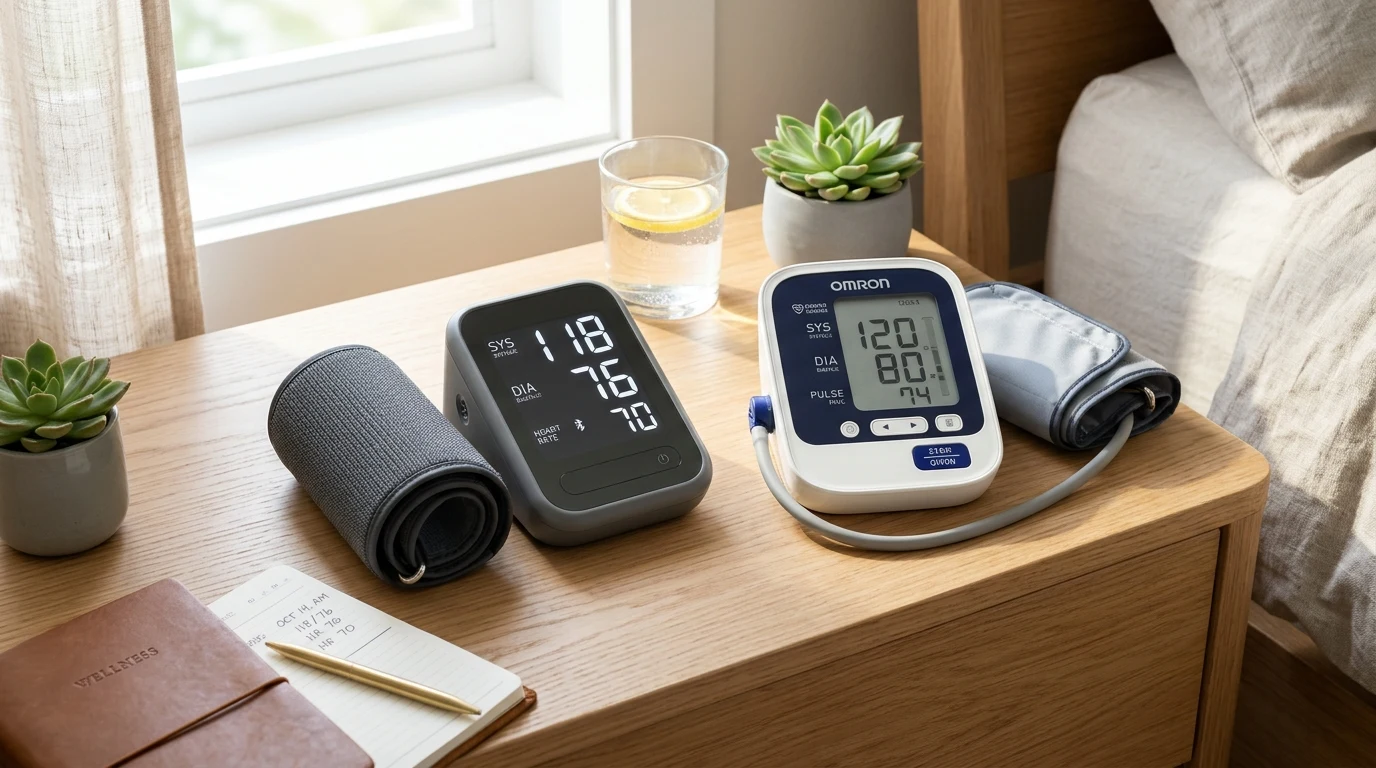
- BP Life: Shines with its massive, high-contrast backlit LED display. The numbers for systolic and diastolic pressure are nearly an inch tall, illuminated brightly against a deep background. Furthermore, a World Health Organization (WHO) color-coded bar along the left edge immediately tells you whether your reading falls into the green (optimal/normal), yellow (pre-hypertension), or red (hypertension stage 1/2) category without requiring you to memorize clinical charts.
- Omron: Features crisp, legible digital LCD displays. However, unless you step up to their higher-priced Series 7 or Series 10 models, lower-tier models lack screen backlighting, making them harder to read in a dimly lit bedroom before the lights are turned on.
Cuff Fit, Comfort & Dual-User Logging
An improperly sized cuff is the number-one cause of inaccurate blood pressure readings. A cuff that is too small produces artificially elevated numbers, while one that is too loose produces false low readings:
- Universal Fit: Both brands include wide-range arm cuffs accommodating upper arms from 8.7 inches up to 16.5 inches (22 cm to 42 cm), ensuring that both slender and muscular arms receive even radial pressure.
- Two-User Household Utility: BP Life allows two separate family members (e.g., husband and wife) to toggle between User 1 and User 2 with a single physical switch, preserving up to 99 independent readings per person with exact date and time stamps so you can present clear trend averages to your doctor.
KerryPicks Verdict & Decision Checklist
Both monitors empower proactive cardiovascular care, each serving specific user needs:
- Choose BP Life if: You prioritize an oversized, brightly backlit screen with instant color-coded risk bars, want seamless dual-user memory without needing a smartphone app, and want exceptional value under $60. Check our verified BP Life discount codes & review for current health deals.
- Choose Omron if: You require Bluetooth synchronization to export digital PDF logs directly into your healthcare provider’s portal via Apple Health, or prefer the clinical reassurance of the American Heart Association’s most widely validated brand.
Frequently Asked Questions
What is the correct way to take a home blood pressure reading?
Sit quietly in a comfortable chair with back support for at least 5 minutes before measuring. Keep both feet flat on the floor (do not cross legs). Rest your arm on a table so the cuff sits at heart level, and avoid talking or moving during the measurement cycle.
Should I measure my blood pressure in the morning or at night?
Cardiologists recommend taking readings twice daily: once in the morning before eating or taking blood pressure medication, and once in the evening before bed. Consistent timing provides the most accurate weekly trendline.
Are wrist blood pressure monitors as accurate as upper-arm monitors?
No. The American Heart Association consistently advises using upper-arm cuffs over wrist monitors. Wrist arteries are narrower and deeper under the skin, making wrist monitors far more sensitive to arm positioning errors.
Affiliate Disclosure
Some links may be affiliate links. This may earn KerryPicks a commission at no extra cost to you. Recommendations are based on independent research and analysis. Learn more

Related Articles
 Reviews & Buying Guides
Akko vs Gamakay: Which Budget Mechanical Keyboard Brand Fits Your Setup?
 Reviews & Buying Guides
Carpuride vs In-Dash Stereo: Is a Portable Wireless CarPlay Screen Worth It in 2026?
 Reviews & Buying Guides